Free Online Bass Lessons
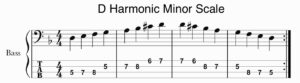
How Harmonic Minor Works in a Minor 2-5-1


This week we’re breaking down a sound that shows up constantly in gospel, worship, jazz, and R&B, but often gets misunderstood.
We’re looking at a minor key progression in D minor:
In this lesson, we don’t just run scales. We explain:
- Why the dominant chord in a minor key behaves differently
- Where the harmonic minor sound really comes from
- Why A Phrygian Dominant fits A7(b9) perfectly
- How gospel players compress all of this harmony into movement
- What bass notes actually sell the resolution
🔑 Key Teaching Takeaways
-
Harmonic minor is not a scale choice, it is a solution
-
The dominant borrows its sound from where it is going
-
Harmonic minor exists only for the dominant moment
-
Gospel harmony is created through motion, not chord spelling
-
Half-step resolution matters more than note count
If you’ve ever felt unsure about what to play over a dominant chord in a minor key, this lesson clears it up in a practical way.
Jump in, slow it down, and listen for the tension and release.
2 thoughts on “How Harmonic Minor Works in a Minor 2-5-1”
Questions? Comments...get in touch!
(you may embed a YouTube or Vimeo video link in your reply)
You must be logged in to post a comment.
Enter Your Email for FREE Bass Lessons




Are You Ready for Full Access to Every Complete lesson?
Become A Bass Nation Member Today!
Remember, with your Bass Nation Membership you will have access to:
Every Complete Lesson
Full Modes Series
Bass Nation Forums
Bass Nation Member Directory
Messaging System
Live Library
and so much more!
Hi Daric, the minor key always confused me. In a major key you have ionian, Dorian, etc. In D minor, D is my 1 and what modes would we be using? D Aeolian, E Locrian, F Ionian, G Dorian, A Phrygian, and etc or do the modes change?
Great question! The modes themselves don’t change. What changes is which note you’re treating as the tonal center.
If you’re in D natural minor (Aeolian), the modes built from that scale would be:
* D = Aeolian
* E = Locrian
* F = Ionian
* G = Dorian
* A = Phrygian
* Bb = Lydian
* C = Mixolydian
So yes, your thinking is correct.
The only thing to keep in mind is that “minor” isn’t always just the natural minor scale. Depending on the harmony, you’ll also run into harmonic minor and melodic minor, which create different modes.
I’ll make a quick video to demonstrate why this works visually on the fretboard because it makes a lot more sense once you see it.